

Date: March 23, 2026
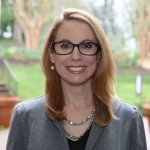
Dr. Christina Shenvi
Guest Skeptic: Dr. Christina Shenvi is a board-certified emergency physician, educator, keynote speaker, coach, and academic leader. She is widely recognized for her work in geriatric emergency medicine, faculty development, and professional identity formation in emergency medicine (EM). She brings deep clinical expertise along with thoughtful perspectives on systems-level change and guideline development.
This is another SGEM Xtra episode. Today’s show focuses on how to build high-quality subspecialty clinical practice guidelines, using the Geriatric Emergency Department Guidelines 2.0 (GED 2.0) as a model.
We’ve talked about Geriatric EM a lot on the SGEM over the years. And if we’re serious about evidence-based emergency medicine, we must be serious about geriatric EM. Here are some previous SGEM episodes:
- SGEM#89: Preventing Falling to Pieces
- SGEM Xtra: Don’t Bring Me Down – Preventing Older Adult Falls from the ED
- SGEM#261: Cristal Ball to Assess Older Patients in the ED
- SGEM#280: This Old Heart of Mine and Troponin Testing
- SGEM#424: Ooh Ooh I Can’t Wait to Be Admitted to Hospital
The original 2014 GED Guidelines were consensus-based and helped establish standards for geriatric emergency departments, including staffing, education, transitions of care, quality improvement, equipment, and protocols. Since then:
- The evidence base in geriatric EM has expanded.
- Expectations for clinical practice guideline development have evolved.
- The GRADE framework has become the international standard for rating the quality of evidence and the strength of recommendations.
GED Guidelines 2.0 represent the first EM subspecialty effort to fully adopt the GRADE methodology and provide a transparent, reproducible model for future EM guideline development.
This work involved a multidisciplinary collaboration, including experts affiliated with organizations such as the American College of Emergency Physicians (ACEP) and the Society for Academic Emergency Medicine (SAEM), as well as geriatricians, methodologists, and patient representatives. Started with an open call to the Geriatric Emergency Medicine community via SAEM, ACEP, AGS, EUSEM, and ENA. With funding via JAHF.
The GED Guideline 2.0 group is planning 14 Systematic Reviews/Meta-analyses, with 6 or 7 Clinical Practice Guidelines. They will all be available on the GEAR 2.0 website
Five Questions for Dr. Shenvi
I have five key questions to frame our discussion about the GED 2.0 Model for Subspecialty Clinical Practice Guidelines. As a reminder, they are called GUIDElines, not GODlines. This means they are meant to guide our care, not dictate care.

1) Why Update the Original GED Guidelines?
The original 2014 GED Guidelines were enormously important because they gave the field its first shared framework for what high-quality emergency care for older adults should look like. But they were developed as consensus-based guidelines at a time when the evidence base in geriatric emergency medicine was much less mature than it is now. Since then, there has been major growth in research, especially through work from GEAR and GEAR 2.0, in areas like delirium, dementia, falls, medication safety, transitions of care, and elder abuse. The update was needed to ensure the guidelines reflected the newer evidence and remained clinically relevant.
A second reason is that expectations for guideline development have changed. The paper makes clear that the original guidelines did not include a formal assessment of the quality, quantity, reproducibility, or applicability of the evidence. In today’s environment, clinicians and health systems expect more transparency about how recommendations are made, how strong the evidence is, and how benefits, harms, feasibility, and equity are weighed. GED Guidelines 2.0 was designed to meet those newer standards.
A third issue was implementation. The original guidelines had a clear impact, especially through ACEP accreditation, but the paper notes that accredited GEDs still represent a minority of EDs, and many sites have struggled with barriers such as limited resources, competing priorities, and a lack of local champions. So, this update was not just about refreshing content. It was also about making the guidance more usable, transparent, and implementable in both accredited and non-accredited settings.
Bottom line, hospitals won’t do things unless there are clear clinical reasons, or financial reasons, or mandates, like CMS measures, which are financial.
2) Why Adopt the GRADE Framework?
GRADE stands for: Grades of Recommendation, Assessment, Development, and Evaluation. They provide a systematic, transparent framework for rating the quality of evidence and grading the strength of recommendations in healthcare.
The group adopted GRADE because they wanted the updated guidelines to be more rigorous, more transparent, and more trustworthy. According to the paper, GED Guidelines 2.0 is the first emergency medicine subspecialty guideline effort to fully adopt GRADE. The attraction of GRADE is that it provides a structured framework for framing questions, assessing evidence, evaluating bias, and connecting the certainty of the evidence to the strength of the recommendations. That makes it easier for clinicians to understand not only what is being recommended but also why.
GRADE also helps move the field beyond expert opinion alone. The new process is grounded in systematic reviews and meta-analyses, and it explicitly incorporates patient values and preferences, health equity, feasibility, and the balance of benefits and harms. That is especially important in geriatric emergency care, where decisions are often preference-sensitive and where the “right” intervention may depend on function, cognition, caregiver context, and resource availability.
- What were the biggest challenges in implementing GRADE in a largely volunteer-driven initiative?
The biggest challenge was GRADE’s resource intensity. The paper explicitly states that it requires trained methodologists, research librarian support, and the completion of systematic reviews and meta-analyses. On top of that, the working group was largely volunteer-driven, and there was variability in members’ familiarity with systematic-review methods and GRADE processes. So, the group had to invest in ongoing training, recalibration, and role adaptation over time.

3) What are the Seven Priority Domains?
The seven priority domains were delirium, dementia, falls, frailty, medication management, palliative care, and elder abuse.
- How were these selected, and were there important areas left out?
They were the result of 6 to 9 months of meetings, starting in 2019. They were selected through a gap analysis of the original guidelines, plus a review of where the evidence base had become strong enough to support a formal guideline. The paper also makes clear that not everything was revised. Some foundational operational elements were intentionally left unchanged because they remained current. So, the omission of some areas was not because they were unimportant, but because the group prioritized where new evidence-based guidance would add the most value.
- How did patient and caregiver input shape the priorities?
Each guideline has involved a patient or a patient’s care partner. Evidence for decision rule meetings when they vote on the level of evidence. The patient or advocate takes part in that meeting and process. For each of the 6 or 7 Clinical Practice Guidelines (CPGs).
4) What is Different about GED Guidelines 2.0?

Dr. Chris Carpenter
Core leaders Dr. Chris Carpenter (expert in methodology and content), Dr. Shan Liu, and seven subgroups with leaders. Greater than 60 people from seven countries, not just physicians, nurses, allied health, methodologists, and patient representatives.
What is most different is that this was intentionally built as a broad, multidisciplinary, international, and methodologically rigorous process. The paper describes a collaboration involving more than 60 members from 23 US states and seven countries, including not only emergency physicians but also geriatricians, nurses, allied health professionals, methodologists, and patient caregivers. That is a broader coalition than many traditional emergency medicine guideline efforts, which are often more specialty-contained.
The second major difference is the method. Rather than relying primarily on expert consensus, this model uses formal GRADE methods, systematic reviews, meta-analyses, and structured PICO questions. The paper presents this as a transparent, replicable framework intended not only to generate better geriatric emergency guidelines but also to serve as a blueprint for future emergency medicine subspecialty guideline development.
A third difference is the emphasis on implementation from the beginning. The model was designed not just to write guidelines, but also to anticipate dissemination, adoption, feasibility, equity, and usability across different ED environments. In that sense, it is not just a content update. It is also a delivery model for creating and spreading subspecialty guidelines in a way more likely to reach frontline practice.
- How does this process serve as a blueprint for other EM subspecialties?
It shows that an emergency medicine subspecialty can develop guidelines using the same formal architecture as other major guideline organizations: broad stakeholder engagement, PICO-based question framing, systematic review, evidence grading, and explicit attention to feasibility and equity. The authors explicitly present this as a replicable framework for other EM subspecialty groups.
- What lessons can be generalized to areas like toxicology, critical care, or ultrasound?
The generalizable lessons are: start with a broad coalition, define the highest-yield clinical questions, pair content experts with methodologists, build systematic reviews before writing recommendations, and plan dissemination early rather than after publication. That is an inference from the model the paper lays out, rather than a direct test in those other subspecialties.
- How do you balance methodological rigour with feasibility and real-world implementation?
The paper’s answer is essentially to do both at once. Use rigorous methods to build trustworthy recommendations, but also weigh feasibility, resource requirements, acceptability, equity, and the realities of diverse ED settings. In other words, rigour should strengthen implementation, not undermine it.
5) Impact of GED Guidelines 2.0
The hope is that it will help create a standard and make it easier, because the group has gone through hundreds of papers and the rigorous process, and the GED group has now summarized them into guidelines, simple diagrams, and best practices. GEAR Delerium
- How do these guidelines move from publication to implementation?
According to the paper, implementation is being built through formal partnerships, centralized access to tools and publications via the GEAR 2.0 website, and planned dissemination activities such as workshops, webinars, podcasts, and role-specific educational content. The authors clearly recognize that publication alone is not enough. We also need social media knowledge translation, as we do on GEM Cast. 
- What barriers exist for non-accredited GEDs?
The paper identifies several factors: limited resources, competing priorities, financial constraints, a lack of local champions, and limited awareness of the guidelines outside accredited centers. Those are practical barriers, not theoretical ones, and they help explain why the updated guidelines are being designed with flexibility and scalability in mind. One screening tool for delirium is the 4-AT Test.
- How do we ensure that this doesn’t just become another well-written document that sits on a shelf?
The test of GED Guidelines 2.0 will not just be whether we publish high-quality recommendations, but whether we help ordinary EDs turn them into workflows, protocols, and decisions at the bedside.
SGEM Bottom Line: The GED Guidelines 2.0 initiative is not just about updating recommendations for older adults, but about demonstrating how EM subspecialties can produce rigorous, transparent, and evidence-based clinical practice guidelines using modern methodologies.
The SGEM will be back next episode with a structured critical appraisal, aiming to cut the knowledge translation window from over 10 years to less than 1 year with the power of social media.
“Remember to be skeptical of anything you learn, even if you learned it on the Skeptics’ Guide to Emergency Medicine.”









You must be logged in to post a comment.