

Podcast: Play in new window
Subscribe: RSS
Date: February 26, 2026
 Guest Skeptic: Terry O’Reilly is the host of the long-running and popular podcast Under the Influence. He is also an acclaimed storyteller and book writer. However, Terry is not just some radio host talking about marketing; he was an adman on the front lines, working in the trenches for 35 years in the advertising industry.
I’ve been a listener of Under the Influence for a long time, and it’s helped me think about how we communicate with emergency clinicians and how we make ideas memorable without overselling them.
I see many similarities with Terry. I’m not just some podcaster talking about emergency medicine. I’ve been working in the emergency department (ED), on the front line, for 31 years. I’m not an academic sitting in an Ivory tower opining on how to practice emergency medicine based on the literature. I worked 17 ED shifts in February. I’m walking the walk while I talk the talk. I think that brings a perspective and credibility to the SGEM, similar to the credibility of what Terry does on Under the Influence.
Terry and I met in person with my wife, Barb, and 11-year old son, Ethan, around 2009. Terry was promoting his book The Age of Persuasion: How Marketing Ate Our Culture. We pulled Ethan out of school to go to Sarnia for a day and watch him give a talk. Terry even signed a copy of his book for Ethan. Our son was so inspired by the event and went on to pursue an academic career in Marketing. Ethan will be defending his PhD in Marketing from the Ivey School of Business this spring.
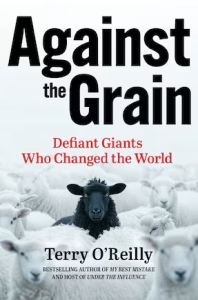 Today, we are going to talk about Terry’s latest book: Against the Grain: Defiant Giants Who Changed the World. It is a collection of stories about people who challenged the status quo and changed what the rest of us thought was possible. It reminded me of Apple’s famous commercial, “Think Different.” I made a parody video about rural physicians titled “Here’s to the Crazy Ones”.
People may be wondering why this matters to emergency physicians. I think the “against the grain” ethos is common in emergency medicine. We have healthy skepticism and often challenge dogma, based on the evidence, when discussing management with other specialties. We also must be good at persuading patients, families, learners, consultants, and administrators that what we are doing is the right thing.
Five Questions for Terry O’Reilly
1) What inspired you to write Against the Grain?
- Was there a single person/story that sparked the project?
- What’s your definition of defiant?
- Did you notice a pattern in how these defiant giants resisted the herd/groupthink?
2) What was one of the most surprising stories you uncovered while researching the book?
- What surprised you: the person’s personality, the risk they took, or how others reacted?
- Was there a moment in your researching a story where you thought, “No way this is true”, and then it was?
3) There are four medical stories in the book (Chapter 4). Most SGEMers probably know about Ignaz Philipp Semmelweis. Can you briefly tell us the story of Dr. Katalin Karikó
- Katalin Karikó and Drew Weissman 2023 Nobel Prize in Medicine for their discoveries concerning nucleoside base modifications that enabled the development of effective mRNA vaccines against COVID-19.
- Do you think healthcare messaging has unique challenges compared with marketing products?
- In your view, what’s the difference between educating vs persuading in healthcare?
 We do need to be careful in science and medicine not to commit the Galileo Fallacy. This is when someone assert a is true or should be given more credibility because the person making the claim has been prosecuted or otherwise mocked. This fallacy originates from Galileo Galilei’s famous persecution by the Roman Catholic Church for his defence of heliocentrism, when the commonly accepted belief at the time was an earth-centred universe. The truth is independent of whether the person is being mocked/persecuted, as with Semmelweis. What matters is the objective, verifiable evidence and logical arguments.
4) What has the feedback been like on the book tour so far?
- Which types of readers are connecting most with it?
- Have any audience questions surprised you?
- Has anyone pushed back on the idea of celebrating “defiance”?
5) What do you hope the audience learns after reading the book?
- If you had to boil it down, what should we be more skeptical of?
- How do we encourage against-the-grain thinking without sliding into cynicism?
The SGEM will be back next episode with a structured critical appraisal of a recent publication. Our goal is to reduce the knowledge translation (KT) window from over 10 years to less than 1 year using the power of social media. So, patients get the best care, based on the best evidence.
Remember to be skeptical of anything you learn, even if you heard it on The Skeptics’ Guide to Emergency Medicine.
Previous SGEM Xtra Book Interviews
- SGEM Xtra – Brian Goldman: The Power of Kindness
- SGEM Xtra – Tim Caulfield: Illusion- What you Don’t Know and Why It Matters
- SGEM Xtra – Steven Novella: The Skeptics Guide to the Universe
- SGEM Xtra – Tim Caulfield: Relax – Damm It!
- SGEM Xtra – Mel Herbert: The Extraordinary Power of Being Average
- SGEM Xtra – Brian Goldman: Casino Shift – Stories from an ER on the Edge (coming soon)
- SGEM Xtra – Darren McKee: Uncontrollable – The Threat of Artificial Superintelligence and the Race to Save the World









You must be logged in to post a comment.